
Latin America has a strong regional human rights protection system, comprising the Inter-American Commission on Human Rights, in Washington DC, and the Inter-American Court on Human Rights, in Costa Rica.
The region was a strong supporter of development and adoption of the Optional Protocol to the UN Convention against Torture (OPCAT), with Costa Rica playing a pivotal role. It filed the first draft in 1980 and, after filing the second draft in 1991, chaired the working group drafting the text. All 17 countries in Latin America (as defined by APT) have ratified the UNCAT, and 14 of them have also ratified the OPCAT and established National Preventive Mechanisms (NPMs).
From 2009 to 2018, the APT supported OPCAT implementation in the Americas from our regional office in Panama. During this time, we supported OPCAT State Parties with the designation and establishment of NPMs and Local Preventive Mechanisms (LPMs) in federal states.
We support NPMs in their work, through bilateral training and advice, as well as through regional workshops and exchanges. We also provide advice and support on torture prevention measures to other stakeholders in the region, such as the judiciary, public defenders' offices, National Human Rights Institutions) and civil society organisations.
Regional activities
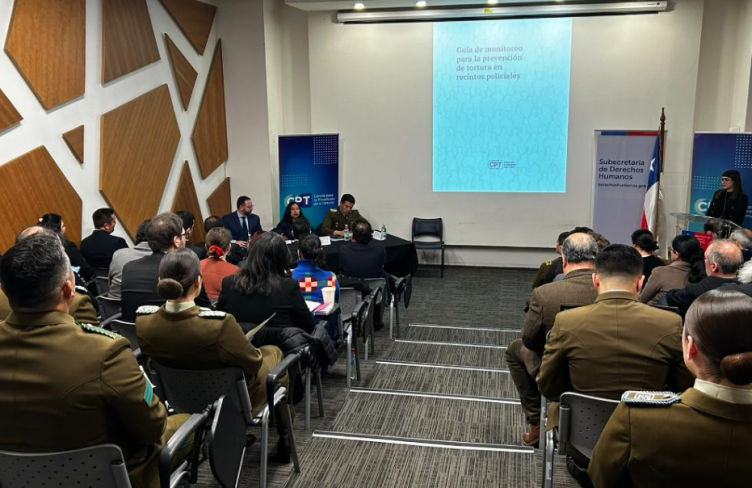
APT has organised several regional workshops with NPMs, with a focus on supporting their work to monitor the first moments of detention. We have also published a series of documents on Safeguards to Prevent Torture in Police Custody in Latin America to identify the main risks in police detention, and best practices in implementing safeguards, such as access to a lawyer and access to information on rights, among others.
An important part of our work is to strengthen a gender perspective in criminal justice systems and to improve attention to persons deprived of liberty at heightened risk of torture and ill-treatment. We joined forces with 12 NPMs in a unique contribution to the Inter-American Court of Human Rights about the situation of LGBTI+ persons deprived of their liberty, to support the drafting of the Court’s Advisory Opinion 29/2023 on differentiated approaches to deprivation of liberty published in 2023. We also raise awareness on the situation of indigenous women and on the situation of persons of Afro descendent within the criminal justice system.
Through our Anti-torture Legislation Overview, prepared in partnership with the Convention Against Torture Initiative (CTI), we contributed to the first regional snapshot of how Latin American countries legislate against torture.
We supported the Network of National Human Rights Institutions (RINDHCA) in the creation of their working group on torture prevention. This cooperation continues, for example in support to RINDHCA publications such as their 2025 guide on monitoring in the context of human mobility. We have also collaborated with the Ibero-American Ombudsman Federation (FIO) and the German Development Cooperation to contribute to the effective functioning of Ibero-American Ombudsman Institutions with an NPM mandate.
Priority countries
Brazil
Brazil has been a priority country for the APT since 2005 and remains so under our 2025–2028 strategic plan due to the depth of work underway across all three strategic goals, and the country’s significance as a regional and global actor. After a challenging political period and a landmark ruling by the Federal Supreme Court about Brazil’s NPM, the federal government has renewed its commitment to torture prevention, creating momentum to strengthen both national and local institutions.
APT promotes effective oversight of the deprivation of liberty, including through technical assistance to existing preventive mechanisms and fostering the expansion of local preventive mechanisms (LPMs). From 2023 to 2024, four new LPMs became operational, with two more expected in 2025. While this progress is encouraging, only seven of Brazil’s 27 states have functioning LPMs, many of which are under-resourced. This makes continued engagement both urgent and impactful.
The APT has also led the development of a new methodology of judicial inspections of prisons, in partnership with the National Council of Justice. This initiative led to the elaboration of a set of manuals and tools that will be adopted by over 1,300 judges across Brazil. For the first time, the judiciary will have a standardised, rights-based framework to carry out its legal mandate of conducting monthly inspections of detention facilities in a systematic and effective way.
To help strengthen dignity and fairness in the criminal justice system, APT has concentrated its efforts on the implementation of legal and procedural safeguards during the initial stages of detention. In partnership with the National Council of General Public Defenders (Condege) and civil society organisations, the APT-led Observa Custódia platform collects and publicises data on detention control hearings and the adoption of legal safeguards in every state. Furthermore, the dissemination of the Méndez Principles among police and legal professionals encourages the greater adoption of safeguards and non-coercive, rapport-based interviewing.
APT contributes significantly to the safety and protection of people at heightened risk deprived of liberty, especially in addressing the intersection of race, gender and sexual orientation, poverty, and torture. Brazil has the third-largest prison population globally, with disproportionate representation of marginalised groups, particularly people of African descent. APT’s work intersects with the UN Expert Mechanism to Advance Racial Justice and Equality (EMLER), and builds on past initiatives related to LGBTIQ+ persons and women in detention.
With staff [SD5] based in Brazil, solid partnerships with institutions and CSOs, and access to domestic and international funding, APT is well placed to continue fostering impactful, systemic change. The country’s influence in Latin America ensures that progress here has the potential to reverberate regionally.
Ecuador
In a context marked by a recent constitutional referendum (April 2025) and an upcoming government transition in early 2026, the country maintains relative political stability despite a deepening security crisis, particularly in Guayaquil, where gang violence and recurrent prison riots have exposed serious structural deficiencies in the penitentiary system. This volatile environment underscores the urgency of strengthening preventive monitoring mechanisms and institutional accountability. APT’s engagement will focus on reinforcing the operational independence and technical capacities of the National Preventive Mechanism (NPM), improving reporting and follow-up of recommendations, enhancing police detention monitoring, and supporting reforms of the National Human Rights Institution (NHRI), to which the NPM is attached—directly advancing Goal 1.
At the same time, APT will promote the effective implementation of fundamental safeguards, including access to a lawyer and the Méndez Principles (Goal 2), while integrating a gender and diversity perspective into detention monitoring, particularly regarding women and LGBTIQ+ persons deprived of liberty (Goal 3). Although political will remains moderate and still evolving, renewed institutional interest in strengthening human rights mechanisms provides an opening for engagement. Ongoing discussions (January 2026) with the NPM and the Ombudsperson’s Office to establish a two-year memorandum of understanding and work plan demonstrate a constructive entry point to assess readiness and deepen collaboration.
APT benefits from strong relationships with the NPM and established partnerships with civil society actors, families of detained persons, and academic institutions working on detention issues. These alliances provide a solid platform for coordinated action and co-creation. Financial support from UKFCDO (until March 2026), UATC (from June 2026), and the City of Geneva—particularly for work on women and LGBTIQ+ persons in detention—combined with regional staff and thematic expertise, ensures the human and financial resources necessary for sustained engagement. Complementarity with the ICRC’s planned expansion of activities in 2026 further strengthens the ecosystem of actors working on detention.
As APT’s first intensive engagement in Ecuador, this initiative represents a strategic opportunity to establish long-term collaboration, fill an existing gap in international support, and position APT as a key actor in torture prevention in the Andean region. By working holistically across its three strategic goals and fostering coordination among state institutions, civil society, and academia.
Paraguay
Having ratified the Optional Protocol to the Convention against Torture (OPCAT) in 2005, Paraguay has demonstrated a longstanding formal commitment to preventive mechanisms. The country currently enjoys a stable political and security environment under a government elected in 2023 and in office until 2028, ensuring continuity of institutional counterparts and predictable operational conditions. While structural challenges persist—including the overuse of pretrial detention, prison overcrowding, and the need for gender-sensitive and rights-based approaches—recent efforts by oversight bodies and civil society reflect a growing recognition of the importance of prevention and institutional reform.
APT’s engagement will focus on consolidating and strengthening the National Preventive Mechanism (NPM), particularly by enhancing its capacity in reporting and monitoring the implementation of recommendations (Goal 1). Building on consistent collaboration since 2021—especially around the Méndez Principles, the dissemination of Advisory Opinion No. 29/2022, and the November 2025 national launch of the Global Report on Women Deprived of Liberty—APT is well positioned to deepen institutional impact. Under Goal 2, APT will facilitate collaborative platforms to advance safeguards and the implementation of the Méndez Principles, notably through strengthened cooperation with the National Police following the October 2025 regional CTI event. Under Goal 3, APT will continue supporting the NPM in addressing the specific needs of women deprived of liberty, children living with their mothers in prison, LGBTI+ persons—particularly through the development of a protocol on the first moments of detention—and potentially indigenous persons deprived of liberty.
Political will in Paraguay is high. APT maintains excellent relationships not only with the NPM, but also with the penitentiary system, judiciary, National Police, academia, NGOs, transgender collectives, and the Public Defender’s Office. The absence of other INGOs working on torture prevention, and the closure of the OHCHR office in 2022, create a unique space for APT to play a leading and complementary role. Financial support from UKFCDO (until March 2026) and the City of Geneva—particularly for work on women and LGBTIQ+ persons in detention—combined with regional staff and thematic expertise, provides the human and financial resources necessary for sustained engagement.
Continued work in Paraguay over the next two years aligns with APT’s Strategic Plan and country engagement criteria, responding to concrete requests from national partners and consolidating reforms with strong preventive value. By strengthening safeguards, promoting gender-sensitive approaches, and fostering coordination among the NPM, Supreme Court, National Police, and civil society, APT can generate transferable practices and lessons learned with regional relevance. Paraguay therefore represents not only a context of institutional stability and strong political will, but also an opportunity to deepen holistic engagement across APT’s three strategic goals and produce sustained national and regional impact.
Latest news from the region

Latin America: How strategic collaboration can drive the fight against torture of LGBTI+ persons deprived of liberty
Friday, February 20, 2026
Paraguay: National Preventive Mechanisms Special Report on the situation of children and adolescents with parents in prison
Wednesday, November 26, 2025